
By: Tom Taylor and Jaclyn Lea
Introduction
There is considerable interest in better understanding how much federal climate funding has been legally committed and how much has been spent. To better answer these questions, we are releasing a new dashboard with data from USASpending. The dashboard, the Project Status Tracker, complements the data on the Outcomes Dashboard. Here’s how:
- The Outcomes Dashboard: tracks awarded funding (announcements from Agencies). These announcements may or may not be obligated.
- The Project Status Tracker Dashboard: Tracks funding under contract and spent by the federal government. The scope is different because of the nature of USASpending and the challenges in pulling program information.
The Project Status Tracker covers nearly 90 programs across nine agencies and $190 billion in obligated funding, $67 billion in outlayed funding and $12 billion in loan funding (face value, i.e. not the cost of the loan). These programs include many important climate programs supported by Inflation Reduction Act and Infrastructure Investment and Jobs Act funding, however these programs may also include other funding appropriations. Note that the funding on the Project Status Tracker is not as comprehensive as the Outcomes Dashboard and does not include any tax credits as that data is not surfaced on USASpending. The data here covers awards starting from the federal government fiscal year 2022 (when IIJA funding began) through the present.
Some data definitions to start:
- Obligations: the federal government’s legal commitment to pay or reimburse recipients for the Federal share of a project’s eligible costs.
- Outlays: The amount actually paid out/ spent by the federal government.
- Loan Face Value: Loan face value refers to the loan value and not the cost of the loan to the federal government. This data is not covered in this data story but is available on the dashboard.
How much has been spent?
Of all obligated funding, 35 percent has been outlayed, however if we remove two of the key Greenhouse Gas Reduction Fund programs (Clean Communities Investment Accelerator and National Clean Investment Fund, where most the funding has been outlayed and now the source of significant legal disputes), that drops to just 29 percent. That means that 70 percent of funds have yet to be spent by the federal government for most climate programs. It is likely that most recipients will have spent more funding than is indicated in USASpending and are awaiting federal reimbursement. However, what this also means is that a very significant portion of the federal legislation is yet to materialize in communities around the country. As more funding is outlayed, communities will come to see the impact of federal investments over the next few years.
A number of programs have very low spending by the federal government to date, for instance see Figure 1 for the 23 programs with less than 10 percent of funding outlayed. Almost all the programs in Figure 1 were newly created in either IIJA or IRA and much of the funding was obligated late in the Biden Administration.


So, why is the rate of spending slow?
There are various reasons why the outlays are low for some programs including:
- Funding is Reimbursable: Technically this tool just tracks federal spending and so recipients may be spending funding to be reimbursed later.
- Projects take time: For major capital projects, it takes years to spend the money. For instance, a public transportation agency will design a request for proposals, select a winning bidder, sign a contract to purchase buses, then the manufacturer will build the buses, then deliver them. It takes time to deliver good public infrastructure.
- New programs, new policy areas: Many programs are new and, in many cases, the subject area is also new for the federal government. Consequently, it can take longer for new programs to be obligated than existing programs. Since funds must be obligated before they can be outlayed, this extended implementation period could contribute to the overall delay in spending.
- Time between awarding and obligations: Much of the funding was only awarded last year and so there’s time to get it in a contract and then even more time to start spending (outlays). For instance, for the National Electric Vehicle Infrastructure (NEVI) Formula Program, while most states had awarded contracts, many were not yet formally obligated in in USASpending.
- Frozen funding: Frozen funding and uncertainty about funding certainly added delays.
- Spending schedules are often backloaded: In theory, grant funding should be backloaded meaning a recipient spends a small amount early to plan, do engagement, and scope the work, and then the larger spend happens later.
What about canceled funding?
There is not a flag in the USASpending data for cancelations, however if the obligated and outlayed totals are zero-ed out, that may signal that the award has been canceled.
This database includes awards that the federal government has claimed as canceled, take for instance the Solar for All awards, or the Industrial Demonstrations awards. The Department of Energy claimed that the awards were canceled earlier in 2025. Atlas hosts a list of programs with obligated funding that Agencies have claimed are canceled and will continue to work to represent canceled funding on the Dashboard while acknowledging complexities in litigation.
What funding has been announced/awarded but not yet obligated?
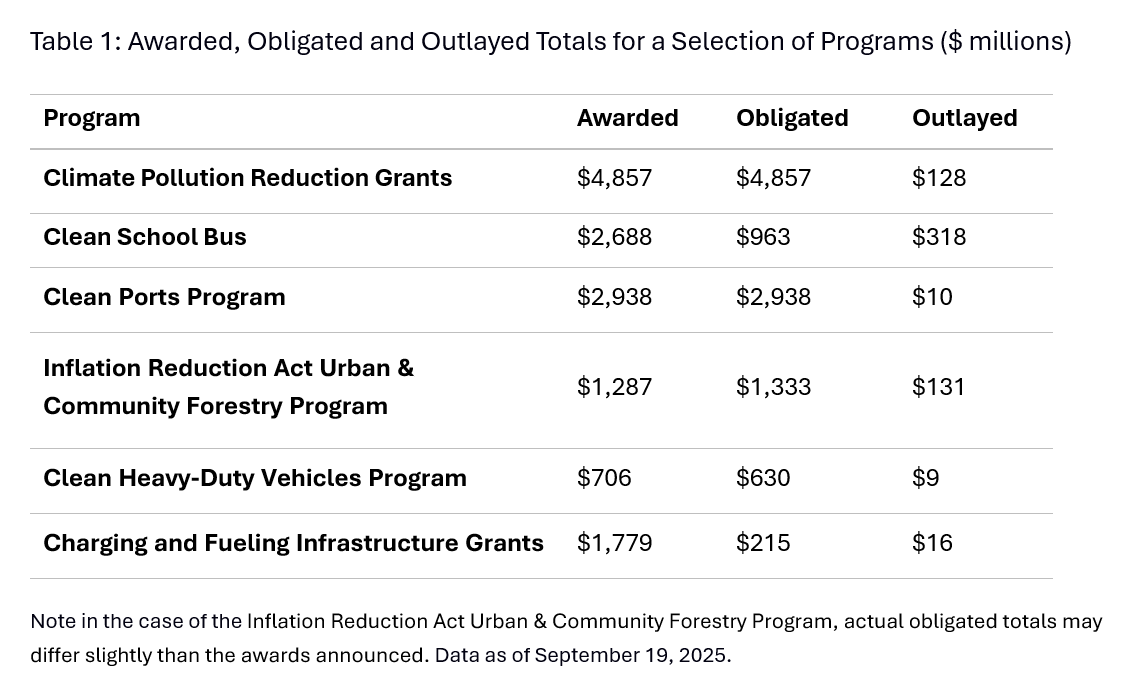
The outstanding question is how much funding was awarded by an Agency but is not yet obligated. To best answer that question, there is a need for program-by-program analysis comparing the data in the Outcomes Dashboard with the data in the Project Status Dashboard. It is worth noting however that in some instances this will not cover programs where states made awards in contracts but the funding is not formally obligated in the federal system – take NEVI for instance. This question is particularly live for some programs that are coming up against deadlines at the end of September, including Highway Infrastructure Programs (NEVI and Charging and Fueling Infrastructure Programs). In Table 1, we carried out matching for some programs to illustrate the different funding types.
What next?
This data will refresh on a weekly basis. We expect grants that are active to continue to outlay funding, while programs that are frozen will likely show little change. Additionally, we will continue to monitor grant cancelations. Explore the data here: Project Status Tracker – Climate Program Portal.
We will continue to add new programs into this list. There are some key programs we have data on that are not in this dataset as we have concerns about the data quality. If you need data on a certain program, get in touch.ded meaning a recipient spends a small amount early to plan, do engagement, and scope the work, and then the larger spend happens later.
Methodology
For most programs, the program listed refers to the program Catalog of Federal Domestic Assistance (CFDA) designation from USASpending, however, in two instances (the Charging and Fueling Infrastructure program and the Carbon Reduction Program), it refers to Program Activities within a larger CFDA. The programs here are a selection of those tracked on the Climate Program Portal and have important climate impacts. Some programs may be listed with other programs for an award by USASpending, we take the first program in the listing.
These programs were matched with the programs covered in scope on the Climate Program Portal, however there are programs that are missing due to challenges in exact matching. The data here covers awards starting from the federal government fiscal year 2022 through the present. This data only covers prime awards and so does not include subaward data, i.e. where a recipient subcontracts with a party to deliver part of an award.
Acknowledgements
Thanks to the team at the National Policy Consensus Center at Portland State University for their input and their CFDA data sharing.