Federal climate policy has shifted dramatically since the start of 2025. The Trump administration canceled $57.3 billion grants and loans, froze funding, cut climate programs, and rolled back clean energy tax credits – triggering lawsuits, halting projects, and ultimately slowing progress on clean energy implementation and deployment nationwide. We will continue to track how actions from the Trump administration impact implementation in 2026 on the Climate Program Portal.
In September 2025, we published a Spotlight on how much federal climate funding has been obligated and outlayed using data from the Project Status Tracker. This dashboard tracks obligated and outlayed funding for key climate programs using data from USASpending to understand progress in implementation. Obligated funding is the federal government’s legal commitment to pay or reimburse its share of a project’s eligible costs, while outlayed funding is the amount reimbursed by the federal government. Currently, our data shows that 38 percent of obligated funds have been outlayed (or 32 percent if we exclude the Greenhouse Gas Reduction Fund due to ongoing litigation over the program’s termination), meaning that most federal climate investments have yet to reach communities.
Despite the growing number of grant cancellations and shifting priorities in the federal government, climate programs continue to advance. Two big questions remain:
- How will fiscal year 2026 appropriations and reauthorization shape climate policy moving forward?
- How will the remaining funding be implemented in 2026?
This data story will explore these questions and what the shifts mean for future federal climate investment.
2026 Outlook for Climate Programs
2026 is a pivotal year for implementation of programs funded by IIJA, marking the end of its five-year funding authorization (FY2022-2026). With IIJA expiring on September 30, 2026, agencies are under pressure to finish obligating remaining funds. There will be considerable focus on the transportation reauthorization bill to determine the shape of transportation and infrastructure projects moving forward. According to a 2025 report from Atlas Public Policy, reauthorization by Congress is important to ensure progress does not stall and that communities nationwide can benefit from reduced costs, job creation, and clean air.
The future of the programs created in and funded by the IRA remains uncertain. In July 2025, Congress enacted the One Big Beautiful Bill Act (OBBBA), rolling back numerous clean energy incentives. The OBBBA also rescinded unobligated funds from many IRA programs, which are discussed here and here. Among the largest program cancellations (other than the tax credits) is the $27 billion Greenhouse Gas Reduction Fund (GGRF). Although all $27 billion from the GGRF had already been fully obligated, the administration froze and ultimately rescinded the funds. These actions are currently being challenged in court.
Amid federal climate funding cancellations, Congress moved to establish new funding levels through the FY 2026 appropriations process. On January 23, 2026, President Trump signed into law the FY 2026 Energy & Water Development and Interior & Environment appropriations bills. These measures will fund the Environmental Protection Agency, Department of Energy, Army Corps of Engineers, Bureau of Reclamation, and the National Park Service. The new law will also support various water projects and climate-related initiatives such as forest management, resilience, and energy. However, much of the energy funding focuses on nuclear energy, totaling roughly $5 billion.
Additionally, funding continues to be administered for numerous IIJA and IRA programs, though they may not prioritize climate-focused initiatives anymore. For example, the EPA recently announced plans to issue a 2026 funding opportunity for the Clean School Bus program. The opportunity is part of the agency’s effort “revamp” the program. While the EPA press release indicates that it would focus on natural gas, biofuel, or hydrogen, the agency is required by law to award at least 50 percent of funding in a fiscal year to zero-emission school buses. Electric school buses are expected to remain eligible for funding later this year, although it remains uncertain whether the EPA will comply with the legal requirement.
Federal Climate Funding Committed and Spent as of 2026
The Project Status Tracker covers nearly 90 climate programs across nine agencies, tracking $210 billion in obligated funding, $79.4 billion in outlayed funding, and $12 billion in loan funding (face value, i.e., not the cost of the loan). Notably, $36.1 billion was obligated in 2025, including $19 billion after Q1, meaning that agencies continued to obligate funding after the inauguration of the Trump administration for programs such as the Federal Transit Capital Investment Grants program, Low Income Home Energy Assistance Program, and Conservation Stewardship Program. It is possible the funding was obligated during the Biden administration, but because of reporting delays or later financial actions, it appears in the data during the Trump administration.
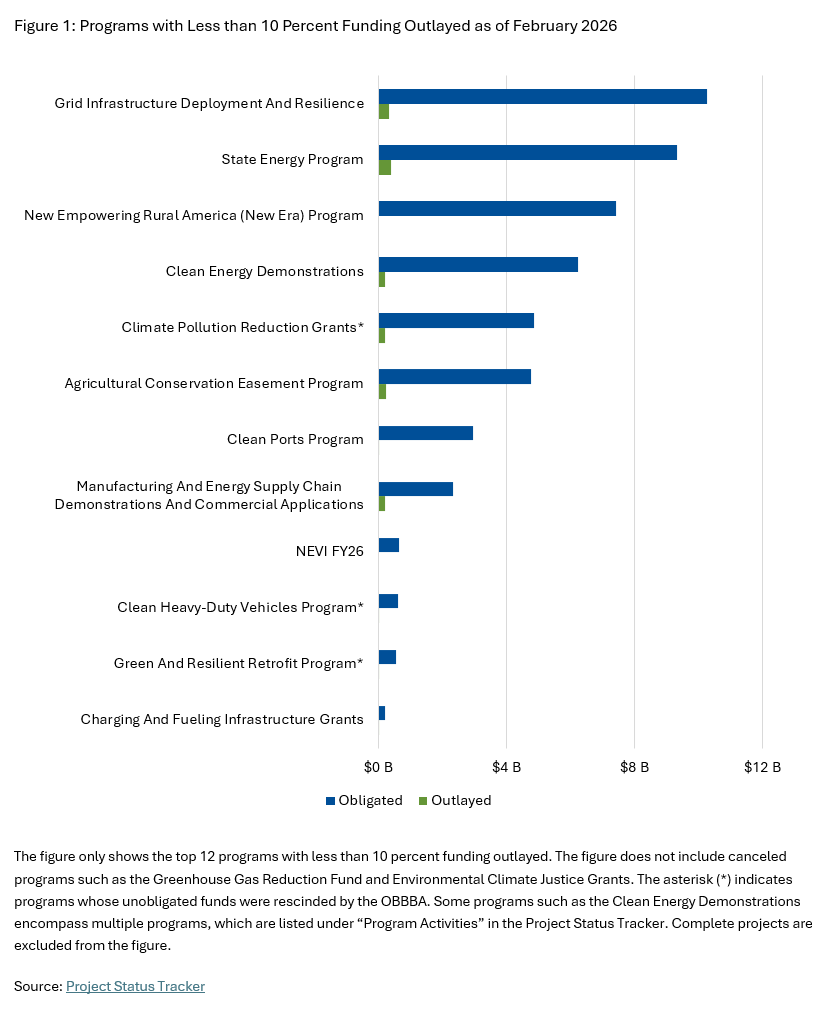
Two programs, the Forest Legacy Program and the Renewable Energy Systems and Energy Efficiency Improvements Program, have outlayed 100 percent of their obligations. However, many other programs still have significant funds remaining to be paid out. Figure 1 shows 12 programs with less than 10 percent of funding outlayed as of February 2026. Notably, a NEVI program appeared in the data in 2026 allowing for closer tracking of NEVI obligations.
Project Statuses and Canceled Funding
On USASpending, a project’s status is based on its listed start and end dates and marked as “In Progress,” “Complete,” or “No End Date.” USASpending defines the start date as “when the awarded recipient’s work begins or when the award is otherwise effective” and the end date as “the end of the award’s period of performance, when the recipient will finish its work or the award will otherwise end.”
Since the cancellations of obligated grants, we have been tracking changes to the period of performance end dates that trigger a status change from “In Progress” to “Complete.” In most cases, a project is complete when the original project end date has passed and all the money has been spent. In other cases, projects may be marked as complete if their end dates were moved up and the project was prematurely canceled. A good example of this is the GGRF Solar for All program. Although projects are marked as “complete”, not all of the obligated funding has been spent. The program was also canceled in August 2025, which is now displayed as the end date for each individual project. Still, as Figure 1 demonstrates, many programs continued to operate even though they were impacted by individual funding cancellations.
Rate of Spending
In our last Spotlight, we explored some of the reasons why the rate of spending is gradual. This year, however, presents a different challenge. Whereas many IRA-climate programs were advancing quickly in 2025, momentum has shifted following the Trump administration’s cancellations and rescissions under the OBBBA. As shown in Figure 1 unobligated funding was rescinded for numerous programs under the OBBBA, such as the Clean Heavy-Duty Vehicles Program, Green and Resilient Retrofit Program, and the Climate Pollution Reduction Grants. Awardees that were announced but where the funding was not obligated will likely not be able to access that funding.
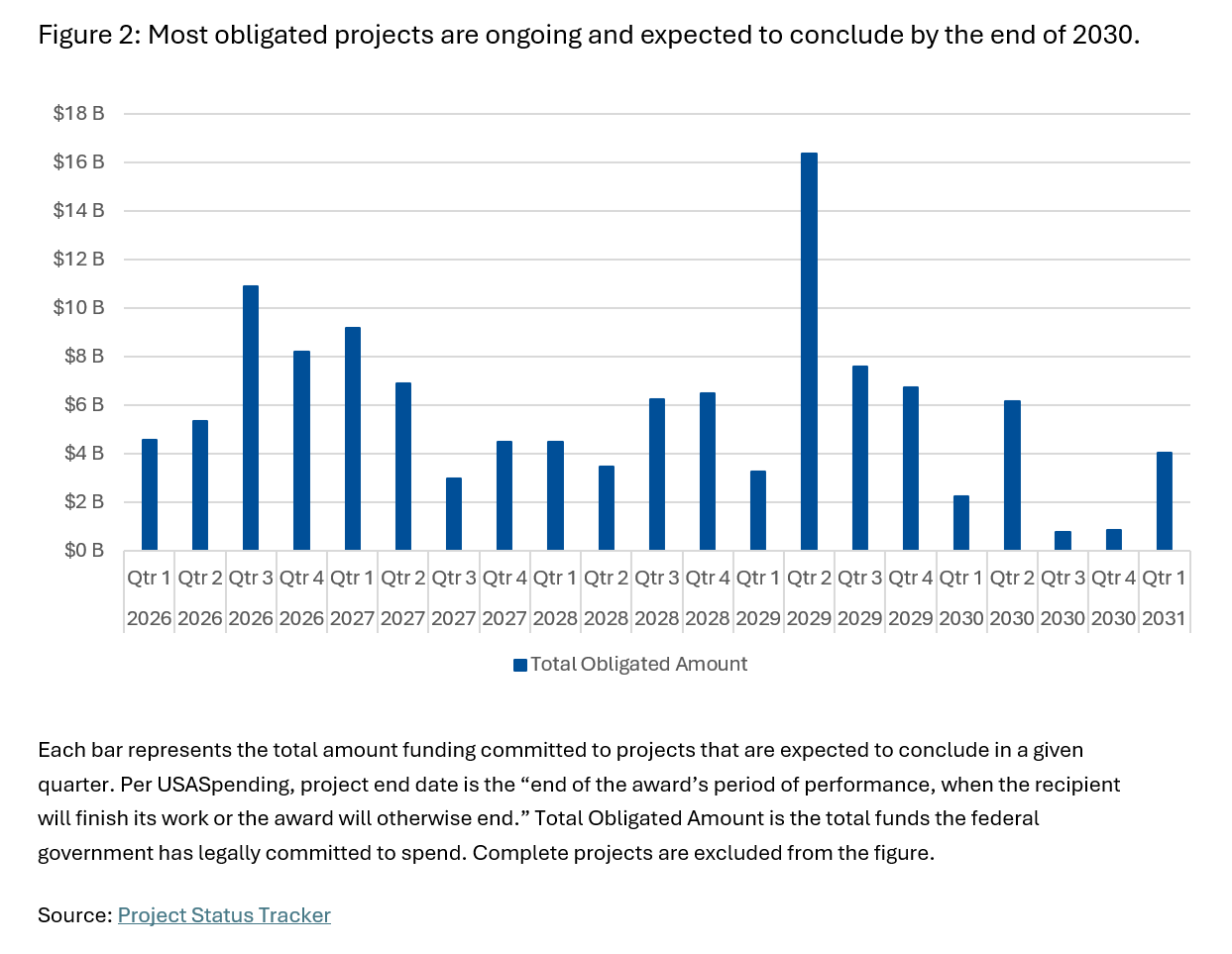
Many projects are still in progress, with end dates extending well into the future. Figure 2 illustrates how these obligated funds are expected to be spent down over the next several years. For example, about $4.5 billion worth of obligated funds have an end date in Q1 2026. Looking ahead, there is $16 billion worth of obligated funds that have an end date in Q2 2029. This tells us that there is still a lot of money that has time to be fully outlayed legally.
What comes next?
There remains a significant amount of funding obligated but not outlayed and not canceled. Awardees must navigate complex terrain to implement funding. Legal battles have emerged over the past year and will likely continue through 2026 as awardees push to get access to their grant funding. The Sabin Center for Climate Change Law is tracking more than 40 IRA-related court cases here.
As this landscape continues to evolve, we’ll keep tracking obligated and outlayed funding to help you stay informed. Check out the Project Status Tracker for the latest updates.